Why is clutter mentally exhausting?
Discover the effects of information overload on your mind and how it may be holding you back from living a lighter, healthier life.
Maria Elisa Nascimento
5/7/20264 min read
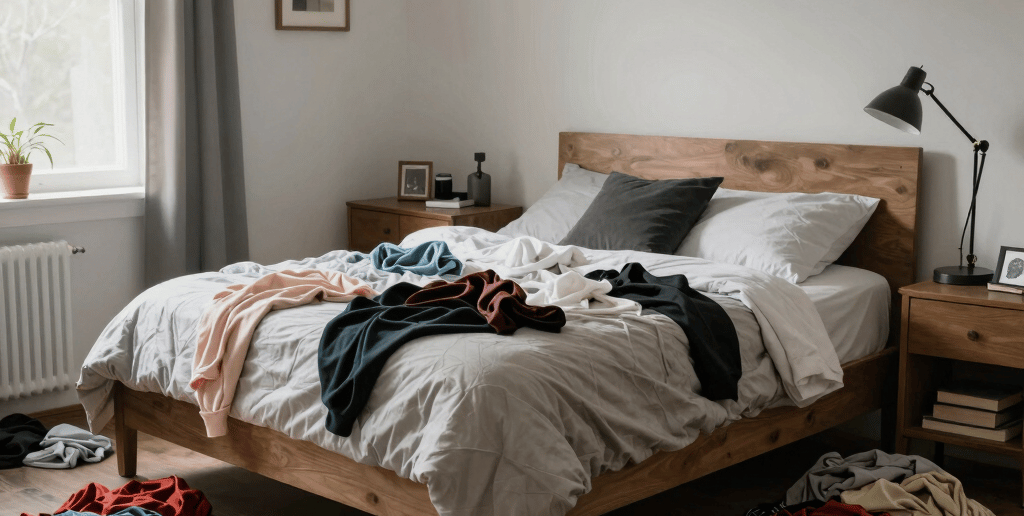
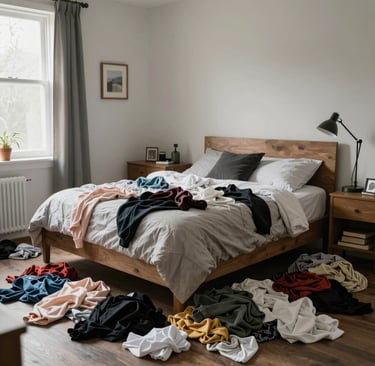
Have you ever felt that your brain works harder to concentrate when you're in a cluttered environment?
It's no coincidence that so many of us experience this feeling. It's scientifically proven that the appearance of our surroundings directly impacts our habits, lifestyle, and mental health – and for women, this effect is even more damaging.
Today you'll discover the effects of information overload on your brain, why getting organised will turn your home into a more welcoming, interesting, and functional space for your daily routine – and we'll also point you towards a way to learn how to get organised.
It's hard to focus on one single thing when there are too many options
You know that feeling when you have so much to do that you don't know where to start? Or when you get lost amongst the endless options on a delivery app or a streaming catalogue? Can you actually make a decision, or do you end up choosing nothing at all?
According to a study from the Princeton Neuroscience Institute, when our visual field is filled with multiple pieces of information, the brain begins to face a neurological competition: different stimuli call for our attention at the same time, so our mind has to work harder to decide which one to focus on. That's why you freeze when faced with too many choices or in overwhelming environments. You are literally stressing your brain out.
For women, the overload can make them ill
Another study, conducted by UCLA, analysed the speech of 30 different families about their perception of their homes. The results showed that the majority of women who described their homes as disorganised had greater difficulty reducing their cortisol levels. As a consequence, they felt more stressed, depressed, and exhausted, driven by the feeling of having endless unfinished tasks.
The difference isn't biological at all — it's social
From a very young age, women are taught to take responsibility for domestic care and management, whilst male socialisation does not demand the same commitment. The same UCLA study, along with other classic and contemporary sociological research, explains that this is why women "notice" dirt more and men can easily ignore clutter. The female gaze is trained to do so.
External pressure becomes internalised, and so a disorganised and dirty environment is felt as a personal reflection of failure and an inability to manage one's own responsibilities. As a result, cortisol levels rise and stress peaks increase.


But do men really not get affected at all?
Even though excessive clutter at home stresses women more, in the practical details of everyday life this accumulation affects both genders: in the difficulty of making decisions or focusing on a single task because of a messy work desk; in the time wasted looking for car keys that end up in a different corner of the house every hour, making you late for work; in the important document that's gone missing or the item of clothing or other object you simply can't find. And that's not all: your eating habits may also be suffering because of the clutter.
Did you know that your pile of unwashed dishes could be what's getting in the way of your diet?
Studies published in the journal Environment and Behavior reveal that the stress caused by a very cluttered kitchen leads people to develop worse eating habits. You know that takeaway you ordered mid-week just to avoid the dirty dishes? Exactly. During experiments, it was observed that participants dealing with very chaotic kitchens consumed twice as many calories — mainly sweets and snacks — compared to those who were in clean, organised environments.
Now that you've found the problem, isn't it easier to understand how to solve it?
If you identified with some of the symptoms discussed in this text, don't worry. The good news is that you now know that organising your spaces and keeping them cleaner is a way to save your brain's energy, feel more relaxed, increase your productivity, and even improve your eating habits.
An organised home becomes a Restorative Home
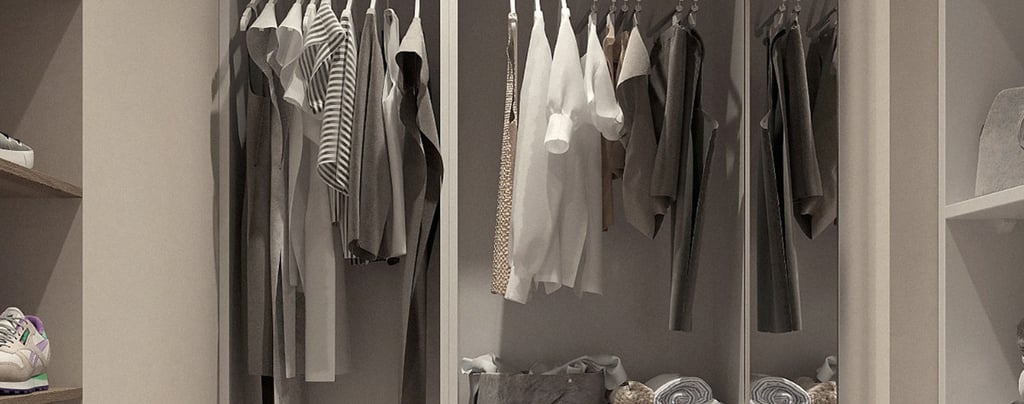
Our home is the place where we should feel cosy and relaxed. It's the space that most reflects our personality and the way we choose to live. Keeping rooms well structured and aesthetically pleasant gives us a sense of belonging and contributes to maintaining a more functional and healthier routine.
Things seem easier to deal with — and they really are — because the brain doesn't have to spend as much energy making sense of them.
Furthermore, having things easily within reach gives us back the feeling of being in control of our lives. We can't control everything, but we can choose how to make the most of our home's space, where each of our belongings will be kept, and how the décor will represent us. And that, as well as making the small practical decisions of daily life easier, is a relief for our mental health.
If you want to transform your home into a more organised, welcoming and functional environment but do not know where to start, Systematic Mind can help. In Dublin, personal organiser Ana Stamato offers environmental organisation services for both individuals and businesses. Want to know more? Get in touch by e-mail ( thesystematicmind@gmail.com) or WhatsApp (+353 83 398 4754).
thesystematicmind@gmail.com
+353 083 398 4754
Dublin, Ireland
© 2025 Systematic Mind. All rights reserved.